Most endurance athletes have been told to stretch. Most respond with “Yeah, I know I should, but don’t.” In terms of cycling, is there value in stretching? If so, how, what, and when?
Flexibility vs Mobility
Before we begin, it is helpful to differentiate flexibility and mobility. Flexibility refers to the passive stretch of muscles/limbs (often using external resistance to help like gravity). Mobility, on the other hand, is active. It reflects how well you can move around a joint (i.e., range of motion). While flexibility underpins mobility, mobility factors in limb strength and is often much more relevant to how you move.
The value
Stretching is not likely to directly impact performance on the bike. Mobility has not been shown to impact power output or efficiency on the bike. The value likely comes from on-the-bike position. Mobility often dovetails with the bike setup.
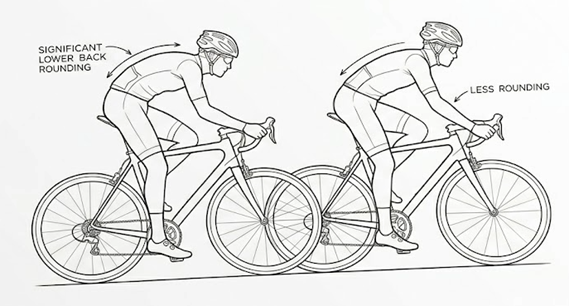
Mobility of the lower back, hips, and hamstrings is often linked with comfort on the bike. Depending on the bike setup, poorer mobility can impair one’s ability to correctly rotate the pelvis to protect the lower back from pain/discomfort (Fig., 1).
Modern bikes, especially racing road bikes, tend to have a large amount of reach and drop (i.e., the bars are further away from you)(Fig., 2). This position requires good mobility to be able to position the pelvis correctly.
Fig 1 below:
.png)
Figure 2: Modern vs older bike drop comparison.
What happens when a cyclist has limited mobility and a very aggressive geometry (lots of reach and drop), they end up riding with a rounded lower back (Fig., 1). This can place the lower back under extra load which can cause pain, discomfort and potentially injury. Beyond the back pain, it can also have a knock-on effect causing saddle discomfort.
While not every case of lower back pain is caused by poor mobility, improving it can sometimes help.
Before the ride
If you are very tight/stiff, doing some dynamic stretches may aid comfort for the upcoming ride. This along with a good warm up on the bike is good preparation before hard efforts. It is important to avoid static stretches before the ride as this will negatively affect performance.
After the ride
While the temptation after the ride is to head straight to the fridge and then the couch/chair, stretching after your ride for 5-10 minutes can help maintain or improve your mobility. It is best to stretch when the muscles are warm. This is best done after exercise but can also be done after a warm bath or shower.
The verdict
Not everyone needs to stretch. Some individuals who have good mobility, may simply need to maintain rather than improve. For those who have poor mobility, improving this with regular stretching may help avoid discomfort on the bike. For some, the equation is simple. Stretch to get more comfortable.
Another note is when considering your bike setup, it is worth factoring in your mobility.